
Interdisziplinäres Doktoranden-Kolloquium: Modelle
Published by Chris Doering,
Interdis. PhD-colloquium
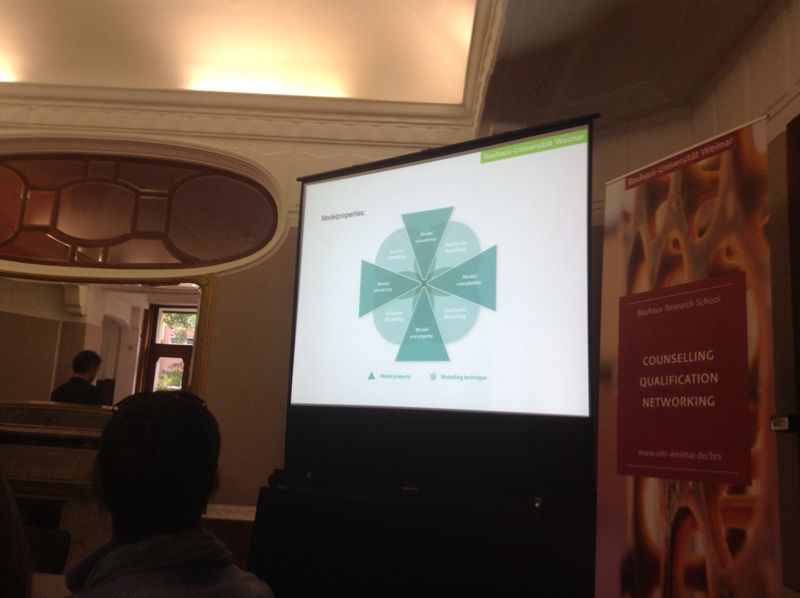
How do you pick the relevant part of reality that you want to model?
How do you know the right level of detail?
What is good enough?
Testing theory in practise?
How can we trist a model? Do you tell us how there are made?
Nano, mocro, meso, makro scale of model
Truth is a scatterplot
Maher Deed:
All models are wrong
Risk, how likely is something, maybe art can help by pusching the scenarios to the limit, evaluation by exageration, for ex. ....if the person weights 1 tonne, then.... We all know this is absurd, so evaluation can be sensed by common sense.... Scenario building eg story telling as an art form
Phd projekt, was ist das modell, das meinem gegenstand der energie planung am nächsten kommt, muss ich ein eigens modell bauen, kann ich andere modelle modifizieren?
Important to know how models are build!
Thousands of models for climate change
Climate change is interesting model because their will be know way to evaluate your action
Forward modelling vs. Inverse modelling
Role of visaulization, you see its not very likely
Mental modelling
Modells represent expectations, not so much realities
Cliche of civil engineers that are positivists who beleive that a reality exists
You dont need to be a hundred percent right, its enough to be seventy percent right