
Discovering hidden influencers that make and break project success | Management Innovation eXchange
Published by Chris Doering,
A provocative research finding is that 75-90% of all large organizational projects fail to meet their original objectives, (Patterson et al. (2006)). The same research suggests human practices and behaviors-- more than technical or financial matters--are at the root of the breakdowns.
Social Network research shows that individuals with a more realistic sense of the organizational networks in which they work lead more effective teams and are more successful in their careers (Krackhardt 1990). This proposed idea (“hack") equips individuals to form a more realistic and saavier sense of their networks and to achieve shared goals more effectively.
We introduce a business “paper-and-pencil" drawing tool where people engage other people in a learning conversation about who influences project success. Derived from social network research and influence analysis, it is a deceptively simple, participatory tool for becoming smarter and more realistic about the people networks in which one is engaged.
For a given problem, participants collaborate to identify a) stakeholders in the problem, b) known links between stakeholders, c) stakeholder motivations for/against specific solutions, and d) their perceived levels of influence on the issue. Diagramming the perceptions of influence around a business problem produces a unique, visible, and valuable form of knowledge --information which is otherwise always fragmented and often hidden in the minds of the stakeholders. This drawing tool provides a structure for diverse individuals to develop a common understanding of the “Outside-In View", as well as, specific opportunities for self-directed, influential actions (“Managing without Managers").
75% of large organizational initiatives, projects and programs fail to meet their original objectives, according to organizational performance research. Analysis suggests human practices and behaviors-- more than technical or financial matters--are the most common causes of project breakdowns. (Patterson et al. (2006)).
Top 4 ineffective Business Behaviors found in large projects which fail to achieve their original purpose (Patterson (2006) are:
- Fact-Free Planning –85% of projects are set up to fail by setting deadlines or resource limits with little consideration for organizational or external realities
- Failure to align organizational interests - 83% of project experience powerful competitive interests which manipulate or derail program priorities
- Unmotivated or unequipped team - 80%of projects have team members unwilling or unequipped to support the project optimally
- Failure to build effective direction-setting alliances- 65% of projects’ organizational commitment & sponsorship is insufficient to achieve the original intended purpose
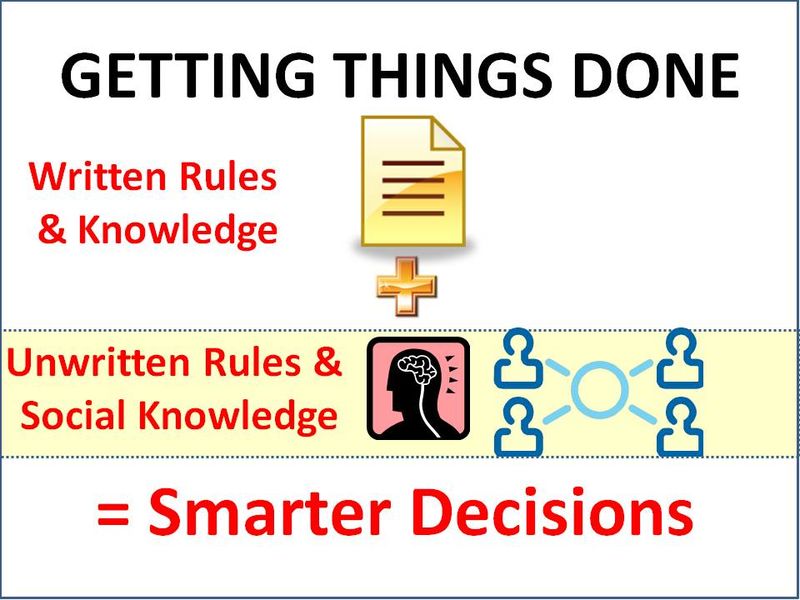 There is a fundamental flaw in the ability of most organizations to effectively execute their strategies. All four business behaviors above point to a systemic inability of change leaders to engage with and influence the networks of people they work with. Sometimes navigating these human systems is scorned as “playing the game of office politics". This inability is worn as a badge of honor. It should not be. Failure to equip staff adequately to discover and address human barriers to organizational effectiveness has huge costs on organizational performance. Projects go over budget or miss deadlines; projects fail to meet quality and required functionality; team morale is damaged; work-life balance suffers.
“Managing without managers" can only succeed if staff are equipped to engage and inspire colleagues and other stakeholders, no matter what the official titles or informal roles are in a business situation. For example, two innovative employees of a global organization, (let’s call them Isabella and Patrick), develop a technical improvement for streamlining customer interactions on-line. However, the full implementation of the innovation is not under their control, but will be influenced by several organizational units and external actors.
Patrick and Isabella recognize that engaging only their direct chain of command is insufficient. They need a tool that helps them identify other core influencers and understand the respective collaborative and competitive motives of each. They also need to find a way of engaging the right influencers to support their proposal.
|
The innovators, Patrick and Isabella, proceed by diagnosing the organizational environment using a pen-and-paper approach called “Net-Map". It is a powerful tool which helps people to interactively identify influence networks and depict the information in an intuitive and quantitative manner. Co-participants are able to visualize and evaluate their own networks within the larger group network. How Collaborative Influencer Mapping (Net-Map) works: |
. |
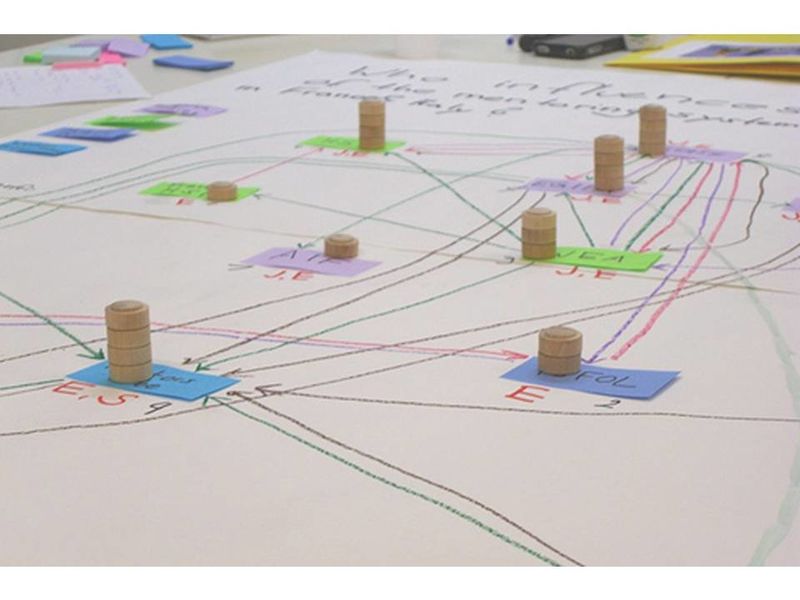
Frame the business challenge as a question to be answered, (e.g. “Who can influence the success of our innovation?") Invite a diverse group of people ranging from one’s own team to other stakeholder groups to have an engaging, learning conversation about the question. Arrange participants in groups from two to twelve people around one large sheet of drawing paper and proceed by asking:
|
Who are all the Stakeholders (hereafter referred to as “Actors")? Individuals, groups, departments, and/or organizations are identified and written on individual cards and placed the map. In Isabella and Patrick’s case, actors from the organization and an affiliated software company are identified and placed on the map. |
|
|
How are the actors linked? Participants decide the different kinds of links (e.g. flow of funding, personal friendships, conflicts, hierarchy, knowledge flow etc.) and draw each link type between the actors in a different color. In the Isabella and Patrick’s simple example, positive links are depicted with green, while conflictual links are shown in red.
|
|
|
Actor motivations towards the goal? The group then explores the goals and motivations of each actor. In this case, the color of the box next to the actors represent whether they support (green) or oppose (red) the proposed innovation. |
|
|
Perceived level of Influence by Actor on the goal? The size of icons are adjusted according to perceived level of influence; the greater the perceived influence the larger the icon. In the pen-and-paper process, influence is often represented with stacked chips (or “influence towers"), each varying according to the group’s perceived influence of each actor.
|
|
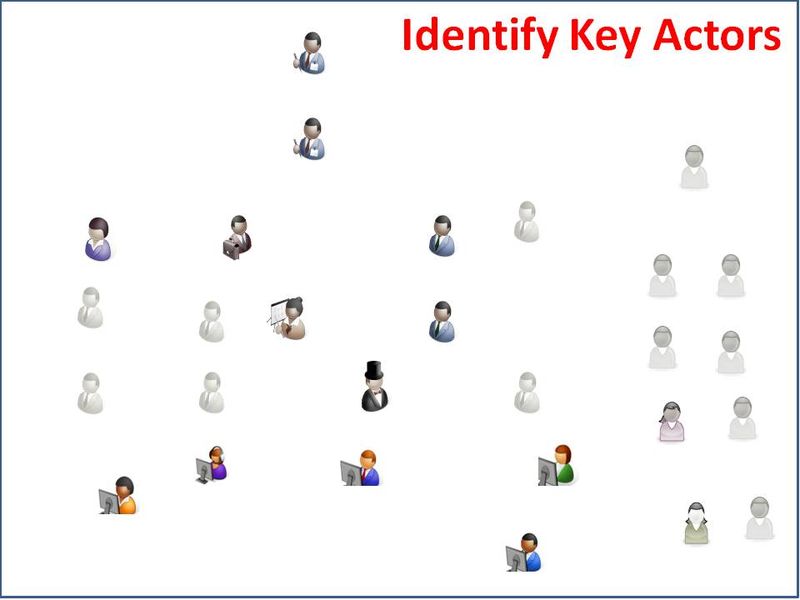
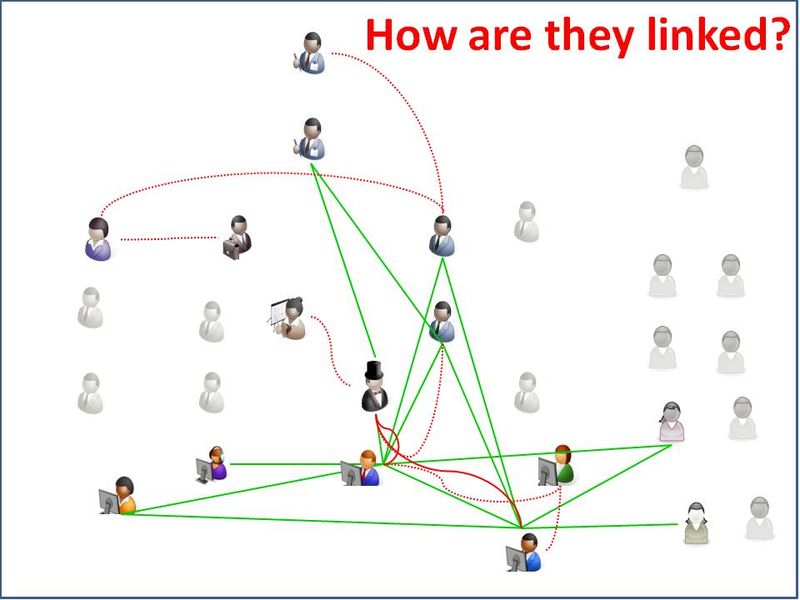
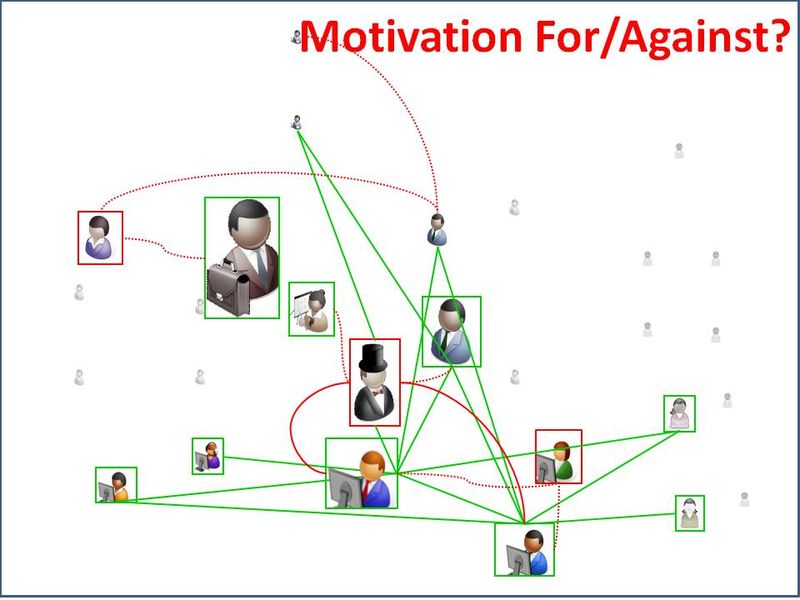
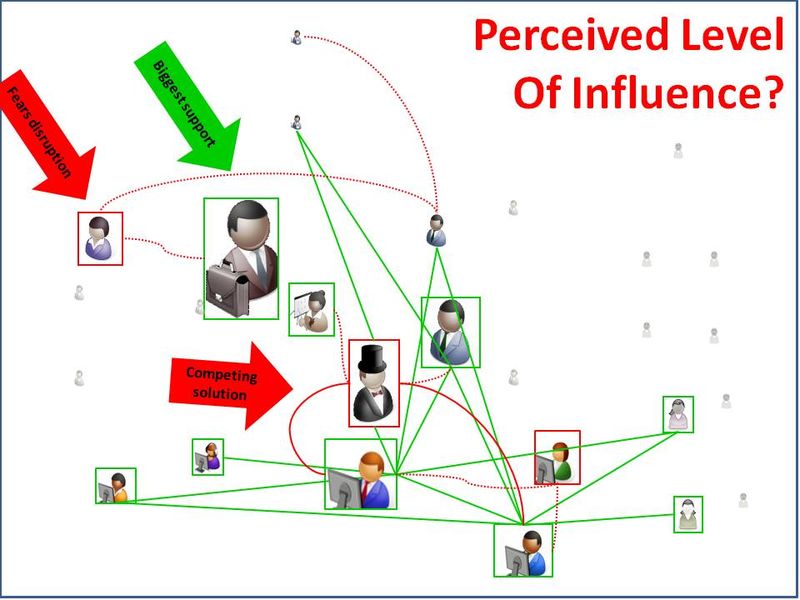
Collaborative learning and interpretation -- Each step in the process elicits engaged, in-depth and focused discussions about crucial issues regarding the challenge: Actors, links, motivations and influence. Once influence levels are explored, discussion of where bottlenecks and opportunities lie helps establish the basis for plan of action, including steps, ownership and timelines for moving forward. The map enables the participants to assess more realistically the feasibility of engaging (or avoiding) key influencers.
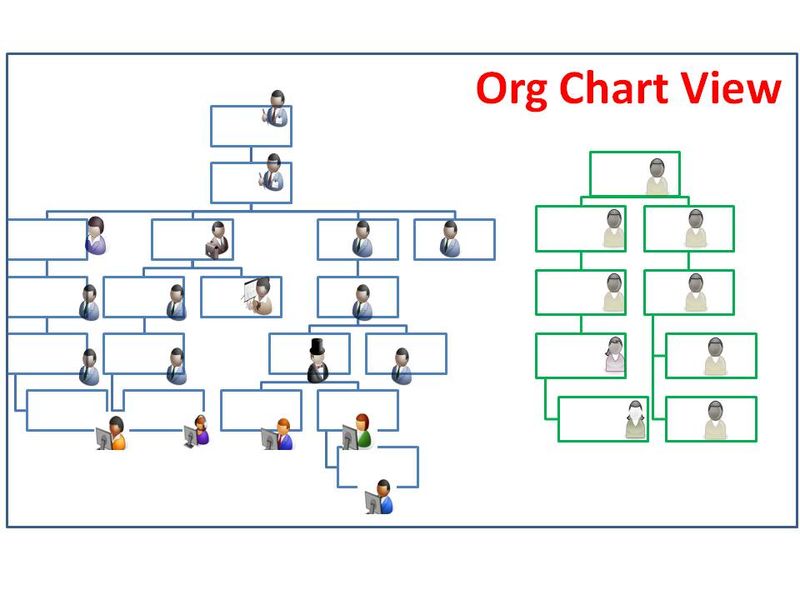
By mapping out influence networks together, decision-makers unearth of insights are not obvious from traditional sources (e.g organizational chart) or from individual perspectives. The level of visibility into organizational dynamics from an Organizational Chart below vs. the visibility from a diagram produced from a group influence diagramming conversation is contrasted below:
|
Original Visiblity (Org Chart View)
|
Visibility from Influence Mapping |
|
|
- New hard facts discovered - a leader had invested in an alternative technology,
- New “social facts" discovered- another key influencer feared innovation-related disruption,
- New critical success factors discovered– a third key influencer would only be supportive after funding for his own pet project had been approved.
Personal interactions also helped motivate participants and trigger action planning by:
- building greater familiarity (trust) with each other and around the specific business issue,
- understanding each other’s reasoning styles, and
- reducing uncertainty around which actions would most likely attract allies or adversaries.
Based on these insights, Isabella and Patrick were able to reframe their approach in order to integrate other people’s goals, secure collaboration and resources from colleagues outside their division, and reduce the risk of offending influential actors by omitting them from key planning activities.
Mapping influence networks can have powerful motivational benefits. For the individual this includes:
- Recognition
- for one’s own unique social knowledge and capabilities
- Learning more of the social / organizational knowledge of others
- Sense of empowerment and influence on the direction and planning of important collaborations
- A tangible sense of contribution to the effectiveness of group is an important source of personal well-being and satisfaction.
For the organization as a whole, other tangible benefits include:
- Saving wasted time and money on ¾ of large projects that fail to meet original objectives
- Cross functional learning experiences build relationships and social capital for responding more rapidly to future boundary-spanning innovations
- Diversity of perspectives deepens the pool of shared knowledge for decision making, usually mitigating risks and biases which like-minded groups do not anticipate as effectively
- More fact-filled planning - Identifying hidden organizational barriers or assumptions
- Document the shared understanding and motivations of the group, reducing the quantity of misunderstandings and miscommunications between diverse and dispersed groups
Human mindsets, behaviors and practices are principal cause of 75% of all large projects going over budget or miss deadlines, failing to meet quality and required functionality. The costs upon organizational performance are huge. It is time to equip staff to influence these human barriers more effectively. Collaborative influencer mapping (Net-map) is a simple, and powerful step in that direction.

Drive: The surprising truth about what motivates, Daniel Pink, http://www.thersa.org/__data/assets/image/0017/327023/watch-animate.gif (Jan 2010).
You need to register in order to submit a comment.

Similar strategy/technique being used in understanding industry structures.
-buy instagram likes
Sometimes to meet the success in life you need to talk to your people in the office listening to their idea and or understand if the employer really understand what are their work. I think this is no idea good that can help if you always the business however we have to stop on blaming others however we have to sit down and learn from the mistakes and do what is best for the company and become the influence of the office to achieve such goals.
-------------------------------------------------------------------------------
extremely entertaining games

Hello John, thank you for your remarks. I wonder if you intended to post this on a different thread?

This technique is also used for understanding industry structure. It is especially helpful in emerging industries where there are many new entrants and many new roles. Mapping the personal relationships (boards and management members) can lead to insights to the eventual structure of the industry and the consolidation transactions.

I use a similar technique in my book The Falconer and working with K-12 students and tried it with a group of West Point cadets in analyzing theoretical systems of interaction in Afghanistan. One group came up with a remarkable four-cornered diagram that brilliantly highlighted that the center of gravity surrounded American forces, while the Taliban actually are well outside of the center of gravity. However it was equally easy to see that if the Americans are removed it will immediately destabalize the system. These were 22 year old students with no training at all on the actual conditions on the ground there, and they immediately developed this tool that could actually save lives through correct understanding of the system.
The technique we presented can be described as an elegant, paper&pencil version of more complex & computerized SNA methods -- in short-- "SNA for non-SNA specialists". Similiar to statistical analysis , the quality of insights will be influenced by the quality and diversity of the inputs included in the analysis.
Take for example, one could poll 10 Democrats about the current performance of a Democratic president. This information would be a useful insight into the party's satisfaction with the President. However, the results might look different if Republicans or Independents were included in the process.
SNA is extremely useful for understanding perceptions of social influence and social connection. But like any analytical tool, how it is applied also influences the insights derived.
Thanks for sharing the example.
This is a powerful technique as it stirs discussions. It is affordable and allows for intensive discussions. Unlike social network analysis software, it does not give statistics of the influencers. However; the technique provides means for building trust gradually leading to the surfacing out of hidden agenda. The illustrations are quite useful

Please have a look here: http://netmap.wordpress.com/case-studies/ for some case studies.
How do you play status games?
very well written, bookmarked it! I was wondering if you have done any live case study on this and got before and after measurable results?
In November last year we organized a net-map workshop on our conference "sustainability and networking" in Lüneburg, Germany. The participants noted that this easy to use tool, the work with pen and paper and the group discussion offers tremendous advantages over computer-aided network analysis tools.
Thanks for the feedback. I think this was an especially interesting experience as I trained your participants in a virtual meeting, using skype (and your in-person support in the room) to teach something pen-and-paper. I was impressed at how quickly they adopted the different steps and started having strategic insights.
Cheers
Eva
I'm struck by how simple this this tool is, and how likely it is that it may be used efficiently and effectively to resolve real life problems. It is attractive in part because the collaborative, participatory nature of stakeholder involvement may result in stakeholders being vested in the process and the outcomes, and the nature of stakeholder involvement may lead to greater satisfaction and compliance with any agreements reached post-mapping.
Great observation. As a facilitator I can only describe it as "the temperature in the room changes" for lack of better words. I have been in situations where participants started out disinterested, desillusioned or even annoyed that they had to be there... And have always been amazed how the speed tends to pick up and all of a sudden everyone is talking at the same time, moving around influence towers and fully engaged - in the mapping and in the plans for future activities.
I consider Net-Map a very useful and flexible “participatory" tool. It is perhaps in this grounded participatory approach where the strength lies. The methodology is non-threatening, easy to use and didactic while mapping people’s needs, assets, expertise, etc. in order for them to make informed decisions about a felt need or new avenue to pursue together. This approach can elicit collaboration, discovery and foster interaction among very different groups of stakeholders.
Thanks for pointing out "non-threatening". Especially if you want to empower those who don't feel like they have a lot to say, it can be difficult to get them involved if they feel like you are the expert with the fancy, polished and expensive tool that took you years of study and secret knowledge to master. Everybody can draw arrows on paper and move around wooden towers, and if you let them, they will...

Highly efficient and productive groups are known to have this in common: they know where the expertise lies in their organization; who to go to for what. This normally develops over time. The process outlined here could be a fast track to that same happy state of affairs.
I have used the Net-Map approach on several occasions for identifying and assessing networks and relationships and found it extremely useful. The technique is simple to be used and adapted to different purposes, which makes it an excellent approach to be share with partners. The approach provided an opportunity for project members to understand relationships among individuals and organizations. It is a powerful tool for planning, monitoring and evaluation.
Nodding in strong agreement with other comments and this hack. I'd add that the visual nature can unlock certain types of conversations that are often hidden in the "word only" approaches we often use (i.e. meetings).
As someone who has used the net-map technique for evaluating how a network would bear on decisions for a proposed technology; I can speak to the true value of this approach. The problem outlined above is very realistic and using this type of technique can at least help a project team/leader understand who bears on what decisions. By examining the influencers, particularly those that are negative toward the project, and leveraging those that are for the project, project success is much more likely to increase. Additionally, applying this technique throughout the life of the project allows you to understand how the attitudes of the influencers evolve.
If you deal with change, whether it be Agile Adoption, introduction of new technologies, or simply standing up and implementing a project, this should be an essential tool in your toolbox.
I'll close that by understanding your network of influencers you can also target two additional Foster Renewal moonshots and an additional Seek Balance moonshot. The understanding will allow you to better "Create internal markets for ideas, talent & resources" since you will have better understanding of motivators behind each infuencer. As you utilize the technique in larger organizations, you can allow organizations to become larger and realize you are dealing with humans and their motivators (which are often emotional); this supports "Disaggregate the organization". And lastly, because you are dealing with motivations of influencers who are not necessarily using a spreadsheet for calculating trade-offs, but are acting more on emotions, you'll be able to "Transcend traditional management trade-offs" more effectively.
Stakeholder participation is key for agility and innovation in project implementation. However, most project management techniques assume a linear algorithm to define social relationships. The esoteric nature of social network analysis is partly to blame for the apathy in incorporating relationships in project plans. NetMap looks like a remarkable simple tool to identify potential risks from conflicting motivations. Impressive indeed!
http://www.managementexchange.com/hack/discovering-hidden-influencers